



How to Measure Your Feet for Walking Boots



Foot length is just the start. Width, volume and arch type all affect boot fit. Here's how to measure all four at home.
Getting your boot size right before buying online takes ten minutes and can save you the hassle of a return. Feet are more complex than a single length measurement: width, volume, and arch profile all affect how a boot fits. This guide explains how to measure your feet at home so you can choose the right size with confidence, whatever route you're taking out with our hiking hub.
Feel free to jump straight in, or if you’re new to mountain footwear, read this deep dive into what a good, comfortable fit should feel like.
Place the paper on a hard floor with one edge against the wall. Stand on it with your heel touching the wall and your weight evenly distributed.
Mark the end of your longest toe with the pen held vertically.
Measure from the wall edge to the mark in centimetres.
Repeat on the other foot. Most people have a slight difference in length — always fit to the larger foot.
Measure in the afternoon if possible. Feet naturally expand through the day and can vary by up to half a size between morning and evening. An afternoon measurement gives the most reliable sizing for walking and mountain use.
You now have your Mondopoint foot length.
Our boots are listed in UK sizes. Use your Mondopoint measurement and select the closest size from the chart below. Mondopoint is an international sizing system based on foot length and is widely used in performance footwear standards.
| Foot Length (cm) | UK Size | EU Size |
|---|---|---|
| 27 | 7 | 42 |
| 27.5 | 8 | 43 |
| 28 | 9 | 44 |
| 28.5 | 10 | 45 |
| 29 | 11 | 46 |
| 30 | 12 | 47 |
| Foot Length (cm) | UK Size | EU Size |
|---|---|---|
| 24 | 4 | 38 |
| 25 | 5 | 39 |
| 25.5 | 6 | 40 |
| 26 | 7 | 41 |
| 27 | 8 | 42 |
If you fall between two sizes, we generally recommend going up.
A slightly larger boot can be adjusted with a thicker sock or insole. A boot that is too small cannot be corrected and is likely to cause discomfort on descents, particularly toe pressure and bruising. Leather boots such as the classic leather boot will mould further to your foot over time, but should still fit well from the start.
Feet also swell during long walks and multi-day use, so a small amount of extra space in front of the toes is important.
If you are exactly on a boundary, choose the larger size.
Length is only one part of fit. Width, volume, and arch shape all influence how a boot feels in use.
Stand on the paper and mark the widest points of your foot on both sides, usually across the ball of the foot.
Measure the distance between the marks in millimetres.
Width is one of the most common reasons a correctly sized boot still feels wrong.
Our boots are designed around a standard width of approximately 98–102 mm (varies slightly by size). If your feet fall within or close to this range, you are likely to fit our standard lasts comfortably.
If your foot is consistently wider than average for its length, we recommend a professional fitting before purchase.
Arch type helps determine insole choice and how the boot should be adjusted — it does not usually change your boot size.
A simple method is the wet footprint test: wet the sole of your foot and step onto a surface that shows a clear print (dark card or dry paving works well).
We have written some advice on how yoou can customise your fit with insoles in your walking boots
Volume refers to the three-dimensional space your foot occupies inside the boot, especially height (instep) and overall fullness, not just length or width.
Volume can often be adjusted without changing size:
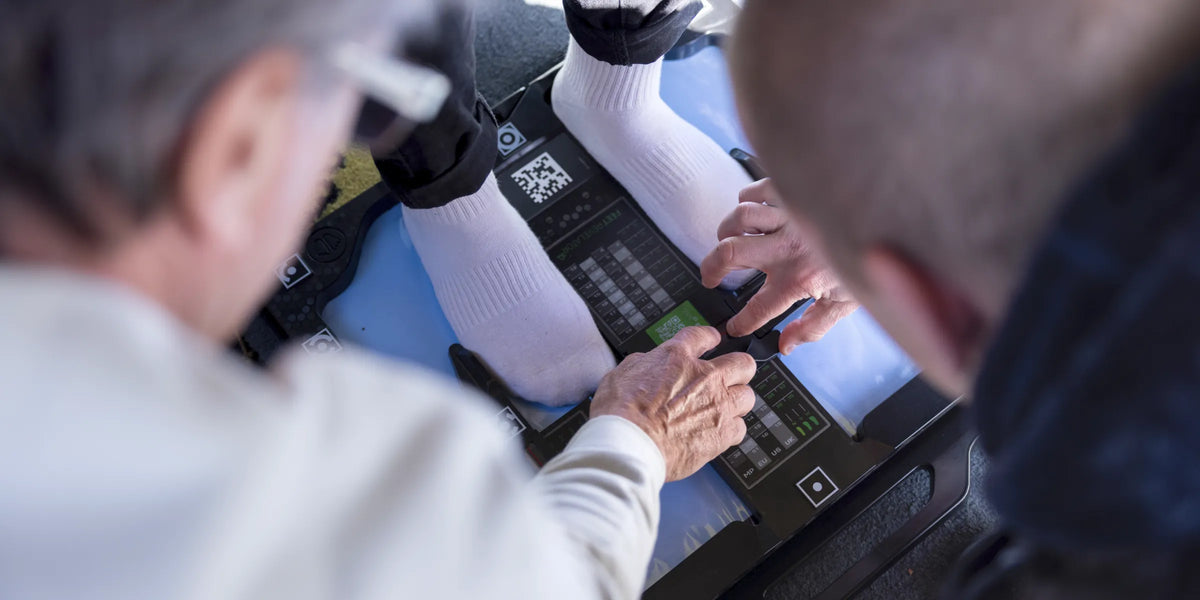
Visit an Alpkit store. Our fitting team will measure both feet, assess your arch and volume, and help you find the right boot and insole combination. It’s the most reliable way to ensure the correct fit.
Alternatively, contact us before ordering and we’ll guide you through it. Once you've got your size confirmed, our guide on how new walking boots settle in covers what to expect next.