



How a backpack should fit: torso length, hip belt and load lifters
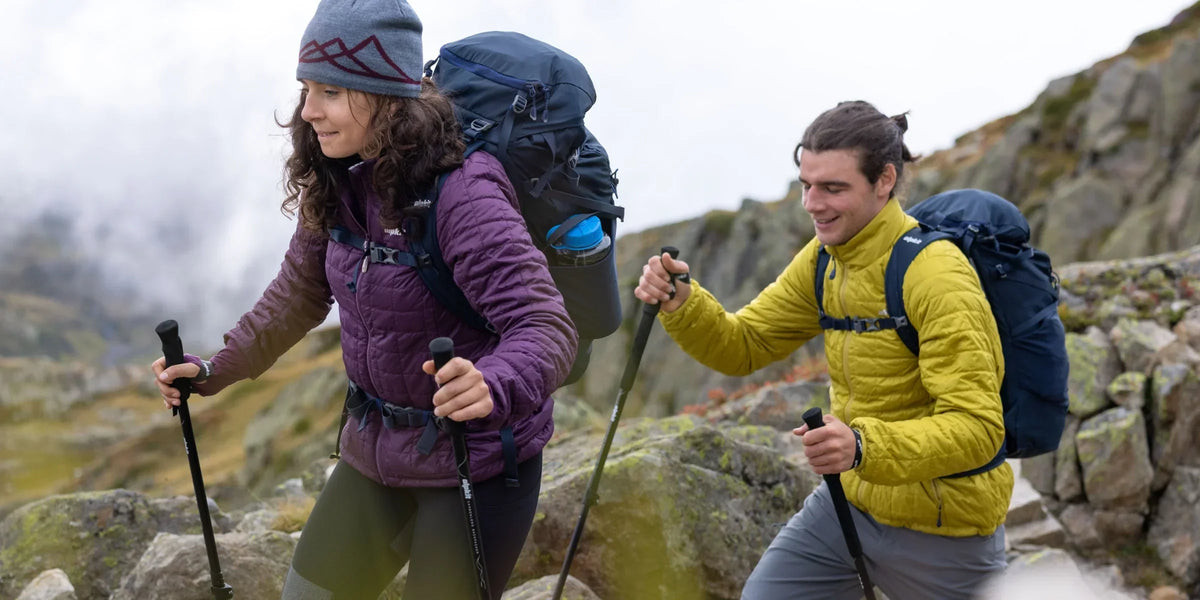



A backpack should carry most of its weight on your hips. How to measure your torso, set the hip belt, straps and load lifters, and fix fit problems.
A backpack should carry most of its weight on your hips. The hip belt sits over the top of your hip bones, the shoulder straps wrap your shoulders with no gap and no digging in, and the load lifters pull the top of the pack in towards you. The sternum strap sits about an inch below your collarbone and stops the shoulder straps sliding apart.
Fit starts with your torso length rather than your height. For how many litres you need, see what size backpack do I need.

In this guide
A loaded pack should sit with its hip belt centred on the top of your hip bones and its back panel close against you, from your lower back up to your shoulder blades. The shoulder straps should leave the pack an inch or two (2–5cm) below the top of your shoulders, then wrap over them without a gap.
How high it sits depends on what you're doing. A walking pack carries its weight low enough for the hip belt to take it. Packs for riding, running and scrambling sit higher, so your hips and legs can move freely and the weight stays over your centre of gravity. The Skytrail 14L mountain bike pack and the Gnarl 15L both ride high on the back for this reason.
Whatever the pack, it should move with you. If it swings when you turn or pulls you backwards on a climb, it's too loose or sitting too far from your back.
Two people of the same height can have torsos several centimetres apart, so a pack fits your back length rather than your height. You'll need a flexible tape measure and a friend.
As a rough guide, under 40cm (16") is a short torso, 40–48cm (16–19") is medium and over 48cm (19") is long. Most packs fit a medium torso best, and their adjustment covers some of the range either side.
A pack with an adjustable back lets you set the shoulder straps to your own back length. The Pacific Crest 65L and Pacific Crest 55L both have one, which helps if you're at either end of the range or sharing a pack. A pack with a fixed back gives you a figure to compare against your measurement: the Orion 45L lists a 450mm back length in its spec.

Then walk about, climb some stairs, bend and twist. If the pack bounces or shifts, start again from the hip belt. Straps settle and loads change through the day, so expect to adjust on the move.
The hip belt carries the load and the shoulder straps hold it in place. Fitting guides commonly put 60–80% of the weight on your hips when the belt fits well, which lets your legs carry it instead of your shoulders and upper back.
The belt goes on your iliac crest, the top of your hip bones, with the padding centred over them. Worn higher, round your waist, it slides up and the weight goes back onto your shoulders. If your hips get sore over a long day, the padding is usually off-centre or too low. If it stops short of the front of your hips, the belt is too short for you.
The shoulder straps should follow the curve of your shoulders and lie flat on your chest. If they dig into the tops of your shoulders, they're carrying weight the hip belt should take, so loosen them a little and tighten the belt. If they gap off your shoulders, they're too loose and the pack will sway.
The same applies to a daypack on the walk to work. Use the waist strap if it has one, and keep the shoulder straps short enough that the pack sits against your back. A pack hanging low on long straps pulls you backwards and loads your shoulders.
The Pacific Crest packs have a cushioned hip belt for multi-day loads, and the Orion 45L a supportive waist belt for winter kit. Lighter daypacks like the Presta 25L use padded hip fins, which keep the pack stable when you're moving quickly.
Load lifters are the short straps that run from the top of each shoulder strap back to the pack, just above your shoulders. Tightening them pulls the top of the pack towards you, so the load sits closer to your back and stops pulling you backwards. Loosening them lets the pack sit further off your back, which helps airflow but makes the pack less stable.
Set them after the hip belt and shoulder straps. Pull them tighter on steep or rough ground, and leave them slacker on an easy path with a light load.
Their angle tells you how well the pack fits your back. About 45 degrees from horizontal is the usual guide. If they run almost flat, the top of the pack is too low for you and the back is probably too short. If they rise almost vertically, the back is probably too long.
The Pacific Crest 65L and 55L both have load lifters for heavy multi-day loads. We've widened the load lifter range on the Ledge 35L and Orion 45L. It makes it easier to get a good fit if you're on the shorter side, and gives you more control over where the weight sits.
The sternum strap clips across your chest about an inch (2–3cm) below your collarbone. It stops the shoulder straps sliding out towards your arms. It doesn't carry any weight.
Set too high, it presses on your throat. Set too low, it squeezes your chest when you're breathing hard. Slide it until it's comfortable and tighten it only enough to hold the straps in place. If no height feels right, refit the shoulder straps first.
Shorter torsos. Look for plenty of adjustment: an adjustable back like the Pacific Crest's, or the wider load lifter range on the Ledge 35L and Orion 45L. Once the shoulders feel right, check the hip belt is still on your hip bones.
Longer torsos. An adjustable back is the safest choice. On a fixed back, watch the load lifters: if they run almost flat once everything else is set, the pack is too short for you.
Women. On average, women have shorter torsos for their height, narrower shoulders and wider hips. Our packs aren't made in separate women's versions, so measure your torso, then pay most attention to the hip belt sitting on your hip bones and the shoulder straps clearing your neck. The shoulder straps on our updated packs are built to fit a wider range of body shapes.
Broad or narrow shoulders. If the straps slide out towards your arms, tighten the sternum strap. If they press against the sides of your neck, loosen it a little and check the load lifters aren't pulling the straps inwards.
Larger bodies. The hip belt is usually the limit. If the buckle only just closes, or the padding stops well short of the front of your hips, the weight will end up on your shoulders. Try the pack on loaded, and check the shoulder straps wrap your shoulders without being at full stretch.
Packs for moving fast fit closer and higher than walking packs, and spread the weight round your upper body as well as your hips.
Running. A running pack should fit like a vest, with no bounce. The Idris 25L has a one-piece back panel and hip belt that wraps round you, for ultras and light overnighters. The Artlu 10L is a vest for fell running kit, and you can tailor its fit to the shape of your torso. Run with the straps tighter than you'd walk, and recheck them as you drink and eat. See our running backpack guide.
Mountain biking. A riding pack sits higher on your back with a waist belt, so your hips are free to move on the bike. The Skytrail 14L keeps the weight close to your back and stays put on technical descents. As Jules puts it: "Sits higher on your waist, rather than on your hips, so enables a wider range of movement." More in mountain biking backpacks.
Scrambling and climbing. A slim pack that sits high keeps out of the way of your arms. The Gnarl 15L sits higher than our larger daypacks, with a low-profile waist strap that stays clear of a climbing harness. With a heavy mountain pack, pull the load lifters in on technical ground so the load can't swing. For choosing between our two mountain packs, see Ledge 35L vs Orion 45L.

| Problem | Likely cause | What to try |
|---|---|---|
| Shoulders ache or the straps dig in | The hip belt is loose or sitting too high, so your shoulders carry the load | Loosen the shoulder straps, refit the hip belt on your hip bones, then bring the straps back in |
| The pack bounces or sways | Loose hip belt or slack load lifters | Tighten the hip belt first, then the load lifters and shoulder straps |
| The hip belt rides up above your hip bones | The back is too short for you, or the shoulder straps are too tight | Loosen the shoulder straps. On an adjustable back, lengthen it |
| A gap between the straps and the back of your shoulders | The back is too long for you | Shorten an adjustable back, or try a pack with a shorter back |
| The hip belt won't tighten enough | It's sitting on your waist, or it's too big for you | Move it down onto your hip bones, where it has something to grip |
| Load lifters almost flat or almost vertical | The back is too short (flat) or too long (vertical) | Adjust the back if you can. If not, try a different pack |
Heavy kit packed far from your back pulls any pack backwards, however well it fits. The art of packing a rucksack shows where things go. If you're carrying a full expedition load, is your DofE expedition rucksack too heavy? helps you cut it down.
See all our backpacks and rucksacks.